
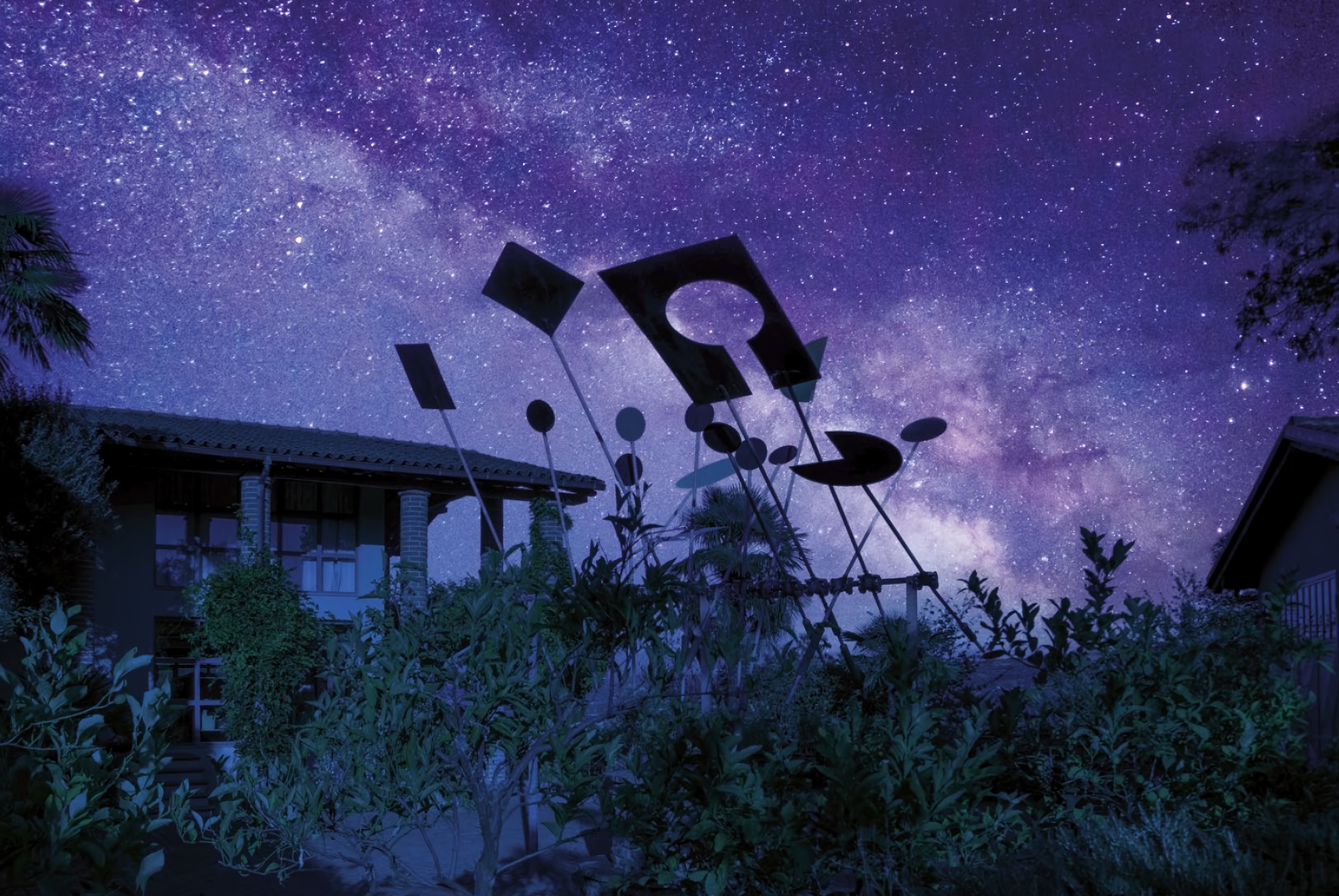

From the Bauhaus and color theory to the artists, teachers, and places that have shaped his life, René Mayer shares the influences behind his creative practice.
For Swiss artist René Mayer, art and design have always been closely intertwined. Trained at the Kunstgewerbeschule in Basel, where he was introduced to Johannes Itten’s influential color theories, Mayer developed an approach to creativity shaped by the principles of the Bauhaus, the importance of craftsmanship, and the belief that art should be part of everyday life. Over the decades, his interests have extended across painting, photography, architecture, furniture, and the decorative arts, informed by the artists and teachers he encountered along the way.
His career has taken him from Basel, where he trained under renowned art photographer Hans Hinz and later founded the design company Mayer & Bosshardt with Karin Bosshardt, to the hills of Piedmont, where he now works and exhibits. Along the way, figures such as Joseph Beuys, Hans Arp, Marcel Breuer, and Ludwig Mies van der Rohe have contributed to his understanding of art and its relationship to the world around us. Equally important are the places, traditions, and personal experiences that continue to inform his work.
In this personal lexicon, Mayer brings together 18 entries that offer a glimpse into his creative world. From the theories and movements that shaped his education to the people who influenced his thinking, and even a favorite Italian dish, each entry reveals something about the experiences, ideas, and enduring interests behind his work.
Lexicon
1. Bubbio
Picturesque, medieval Italian village (approximately 1,000 inhabitants) nestled at the foot of the Langa Astigiana hills, in the southern Piedmont region, in the province of Asti. Viticulture is the village’s primary source of livelihood, and it also offers a diverse and high-quality agrotourism experience.
2. Brasato
Abbreviation for brasato di manzo, which means braised beef roast in red wine (René Mayer prefers Barolo.) The detailed recipe for this brasato will be shared soon.
3. Color theory
Color theories – from Newton and Goethe to Kandinsky and Delaunay – are both science and art. In short, they describe the psychological impact of colors on humans and also explain how to use colors in art and graphic design. One of the most important color theories still taught today is that of Swiss painter and teacher Johannes Itten (see point 10), who designed his famous color wheel in 1961.
4. School of Arts and Crafts Basel
Originally, the school was called the Kunstgewerbliche Abteilung der Allgemeinen Gewerbeschule Basel, which was quite a mouthful! So, the commonly used term was Kunstgewerbeschule (in this glossary, we use this term). Here, René Mayer learned Itten’s theories that continue to guide him to this day (see points 3 and 10.) In 1980, the institution was renamed the School of Design.
5. Hans Hinz
Hans Hinz (1913-2008) was a master of art photography. In his Basel studio, he trained around twenty young people in this complex technique. René Mayer was one of them. He assisted Hinz in photographing in famous museums like the Prado in Madrid, where they had to work at night (the museum was closed) and were monitored by security personnel to ensure they didn’t commit any damage or theft.
6. Preparatory course
Students in secondary education levels I and II often do not have the necessary knowledge to undergo a comprehensive education in the fields of art and design. That’s why preparatory courses, known as Vorkurse, were established in Germany and Switzerland over 100 years ago (see points 10 and 11), providing future students with the necessary foundation for a successful start to their studies. In the past, these courses were a prerequisite for access to specialized classes. Today, they are mandatory in some programs and optional in others.
7. Joseph Beuys
Joseph Beuys (1921-1986), a German conceptual artist and professor at the Düsseldorf Art Academy, aimed to revolutionize art education in the 1960s. On one hand, he welcomed everyone in his classes who wanted to dedicate themselves to art, even if they didn’t have the officially required qualifications. On the other hand, he encouraged artists to engage personally in art education, following his famous motto: «To be a teacher is my greatest work of art.»
8. Alfred Gruber
The Austrian sculptor Alfred Gruber (1931-1972) emigrated to Switzerland in 1955 and settled with his wife in Dittingen, in the canton of Basel-Landschaft. He collaborated with Albert Schilling and Hans Arp (see point 9.) From 1963, he taught at the Kunstgewerbeschule Basel (now the School for Design.) When the couple left Dittingen for the United Kingdom in 1972, they handed over their house and studio to another immigrant artist: the Czech artist Čeněk Pražák.
9. Hans Arp
The Alsatian artist Hans Arp (1886-1966) was primarily known for his sculptures. He participated in the Dada movement and later the Surrealist movement, along with his wife Sophie Taeuber-Arp (1889-1943), who was renowned as a painter and dancer. After World War II, his fame grew rapidly, and he received commissions from all over the world. The Strasbourg Musée moderne et d’art contemporain houses numerous works by Hans Arp.
10. Johannes Itten
Swiss painter and teacher, developer of a color theory that is still taught today (see point 3). Johannes Itten (1888-1967) was a teacher at the German architecture and art school Bauhaus in Weimar (see point 11), where he introduced a preparatory year called the Vorkurs (see point 6). Later, he implemented this course in other educational institutions as well. At the end of his career, he headed the Kunstgewerbeschule, the Kunstgewerbemuseum, and the Textilfachschule in Zurich. Itten’s goal was to unleash the creativity of the students and develop their craftsmanship skills.
11. Bauhaus
Founded in 1919 in Weimar, Germany, by Walter Gropius, the Bauhaus was a school for architecture and applied arts. The Bauhaus profoundly and sustainably influenced the evolution of architecture, painting, design, and the applied arts worldwide. It was closed in 1933 under pressure from the Nazis, who claimed it taught «degenerate art.»
The original motto was: «We must all return to craftsmanship! For there is no art by profession. There is no essential difference between the artist and the craftsman.» In 1922, Gropius changed this creed and advocated for creativity based on rationality. The goal was to industrialize the production of contemporary consumer goods to make them affordable for everyone. The motto became: «Art and technology – a new unity.»
Many world-famous creatives attended the Bauhaus as «Masters» or «Apprentices» (teachers or students), including Marcel Breuer (see point 13), Ludwig Mies van der Rohe (see point 14), Johannes Itten (see point 10), Wassily Kandinsky, Paul Klee, László Moholy-Nagy, Lyonel Feininger, and many others.
12. Goetheanum
The Goetheanum, designed by Rudolf Steiner based on the principles of anthroposophical architecture (see point 15), is named after Goethe, whose scientific works fascinated Steiner. It serves as the headquarters of the anthroposophical movement and is located on a hill in the village of Dornach in the Canton of Solothurn, approximately 10 km from Basel. The surrounding area features villas designed in the same organic style as the Goetheanum.
13. Marcel Breuer
Marcel Breuer (1902-1981) was one of the most influential furniture designers of the 20th century. His designs combined functional aesthetics and technical rationality, in line with the Bauhaus principles. He was a student and later a lecturer at the Bauhaus (see point 11.) Breuer is known for creating the famous B3 chair, also known as the «Wassily Chair» because it is believed to have been designed for Wassily Kandinsky, who had a dream of a Chesterfield-style chair. Breuer reportedly gifted Kandinsky a B3 chair, saying, «Here’s your Chesterfield. I just removed everything that defines a Chesterfield!» Whether it’s true or not, it’s a well-crafted story.
14. Ludwig Mies van der Rohe
Ludwig Mies van der Rohe (1886-1969) was a prominent figure in modern architecture in both Europe and the United States. He served as the last director of the Bauhaus from 1930 to 1933 (see point 12.) As an advocate for minimalist aesthetics, he developed the architectural concept of «skin and bones», which involved a free-standing structural framework covered by a lightweight, unadorned curtain wall. His favorite motto was «less is more». Some of his most fascinating works include the German Pavilion at the 1929 Barcelona International Exposition and the Farnsworth House in the United States. Mies van der Rohe was also a renowned designer, known for the Barcelona Chair.
15. Anthroposophical Architecture
Anthroposophical architecture is part of the organic architecture movement initiated by Frank Lloyd Wright in the early 20th century in the USA. The goal of this movement was to create architecture based on a holistic view of life – an architecture in which art, science, and spirituality harmonize in form and function to create a “total work of art.”
Rudolf Steiner realized this concept in the two Goetheanum buildings (see point 12) constructed in Dornach. The first one fell victim to a fire at the end of 1923, and the second one was started in 1924 and completed in 1928. Numerous “organic” buildings were constructed in the vicinity of the Goetheanum.
16. Mayer & Bosshardt
In the early 1970s, René Mayer met Karin Bosshardt. They quickly discovered that they were the ideal team to establish the company that René Mayer had dreamed of. With a lot of hard work, they founded and developed Mayer & Bosshardt in Basel. In 1990, the company was converted into a public limited company (AG). In May 2022, a new team took over Mayer & Bosshardt AG and continues to run the company in line with the founders’ vision.
17. Coffee Service from Apulia
This coffee set, named “Bari” by René Mayer, enjoyed tremendous success in Switzerland. The range was quickly expanded to include tableware and kitchenware in the same style. Since the initial contract manufacturer could no longer meet the entire demand, René Mayer and Karin Bosshardt searched for additional workshops in Apulia. This led to the creation of a small production network that was both highly artisanal and very efficient.
18. Bergolo
Bergolo is a tiny Italian village (approximately 70 inhabitants) located in the province of Cuneo in Piedmont. Despite its small size, the village boasts significant cultural activity, with regular festivals, art competitions, concerts, exhibitions, and more. In the disused chapel of San Sebastiano, René Mayer was able to hold his first exhibition in 2021, thanks to the intervention of an artist and curator who had stumbled upon his work almost by chance.